


Insights
Technical thinking you can use.
Practical guidance on standards, tax and reporting — written by our team for finance leaders and boards.
 Professional guides
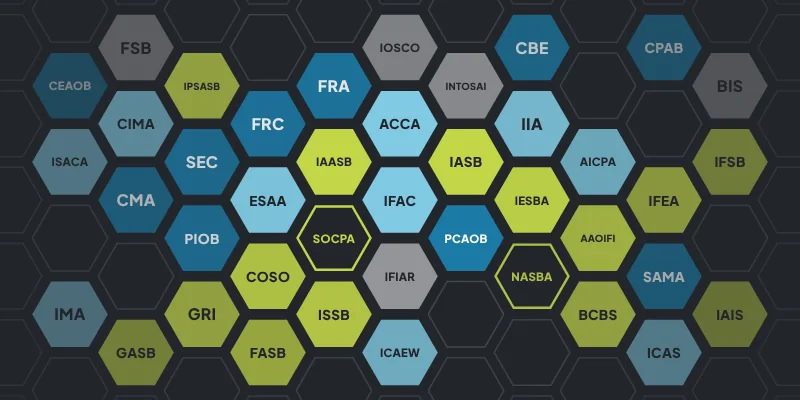
Who sets, enforces and licenses: the profession's institutions
A structured map of the institutions that set standards, oversee audit quality, educate accountants and license auditors, with their counterparts in Egypt and Saudi Arabia.
 AI & Technology
AI in audit: what has really changed, and what hasn't
AI is reshaping how audits are performed, moving from sampling to testing entire populations. Yet the core of the profession, professional judgement and responsibility for the opinion, has not changed. We look at what standard setters say and what it means for entities in Egypt.
 AI & Technology
The other face of AI: deepfakes, financial fraud, and the role of management and auditors
Fraud no longer relies only on a forged document or a copied signature. It now uses synthetic voices and faces that are almost indistinguishable from real ones. We look at the main forms of this risk, what has changed in the auditing standard on fraud, and the practical controls every entity needs.
 AI & Technology
AI and jobs: who gets replaced, and who moves ahead?
The latest international studies suggest AI will reshape jobs more than it eliminates them, with routine tasks most exposed. What does this mean for accounting and audit, and for young professionals starting their careers in Egypt?
 Economy
Egypt's economy in 2026: what it means for this year's financial statements
With annual inflation easing, interest rates still high and significant exchange rate movements in recent years, Egyptian entities face a set of sensitive estimates when preparing their 2026 financial statements. We review the key indicators and their practical accounting effects.
 IFRS
IFRS 18 in Egypt: what changes and when it applies
IFRS 18 replaces IAS 1 from 2027. What changes in profit or loss, cash flows and notes — and whether the 2027 date applies to Egyptian statutory accounts.
 Transfer Pricing
Transfer pricing in Egypt: a practical guide for groups
Who must document, what the Local File and Master File should contain, how to choose a method — and how to prepare for a TP inspection.
 IFRS 9 / ECL
Building a defensible ECL model under IFRS 9
Simplified vs general approach, PD and LGD, forward-looking information and the documentation auditors expect to see.
 Advisory
Financial due diligence: scope, procedures and red flags
What a buyer or investor should expect from financial due diligence — quality of earnings, net debt, working capital and deal risks.
 IFRS 9 / ECL
ECL on trade receivables: the provision matrix step by step
How to build loss rates from historical data, adjust for the future, and avoid the most common errors we see in practice.
 IFRS
Revenue recognition: getting the five-step model right
Performance obligations, variable consideration and timing — practical pitfalls under IFRS 15 and its Egyptian equivalent.
 IFRS
Leases on the balance sheet: implementation lessons
Lease term, discount rates, modifications and disclosures — what finance teams most often get wrong.
 Tax
Claiming double tax treaty benefits in Egypt
Tax residency, beneficial ownership and the documents you need to apply reduced withholding rates with confidence.
 Tax
Preparing for a tax inspection: a readiness checklist
How to organise your files, reconcile your returns and manage the process before, during and after the inspection.
 Reporting
Consolidated financial statements: common errors in group reporting
Control assessments, intercompany eliminations, non-controlling interests and foreign operations — where groups slip.
 Startups
Your startup's first audit: what investors expect
Getting audit-ready early — revenue, share-based payments, convertible instruments and the controls investors look for.
Articles are for general information only and do not constitute professional advice. Please contact us to discuss your specific circumstances.
Let's talk
Clear answers start with the right conversation.
Tell us about your reporting, tax or advisory needs. We aim to respond within one business day.