

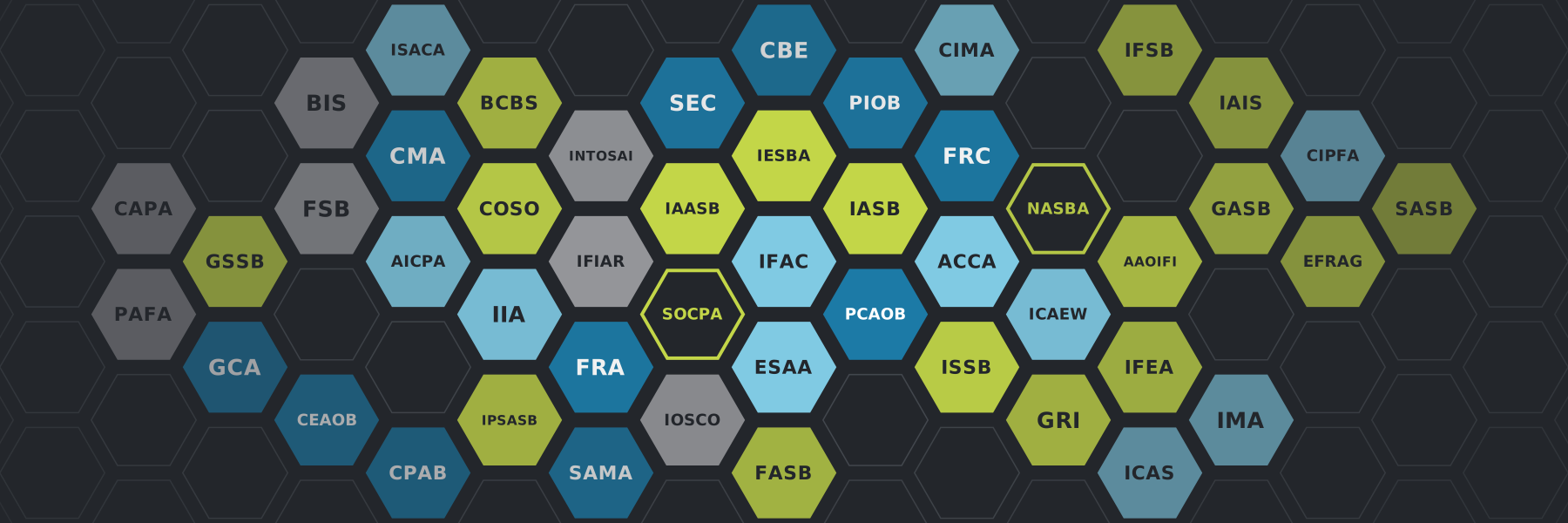
For example: IFAC, PCAOB, SOCPA, the Financial Regulatory Authority
Introduction: Who Sets the Rules, Who Enforces Them and Who Is Authorised to Practise#
The accounting and auditing profession operates within an extensive international framework of institutions, professional organisations, standard-setting boards, regulators, oversight authorities, and licensing bodies.
Each plays a distinct role in shaping professional practice. Some develop accounting and auditing standards. Others establish ethical and independence requirements, provide professional qualifications, monitor audit quality, investigate misconduct, or determine who is legally authorised to undertake statutory audits.
Throughout their careers, accounting and auditing professionals encounter acronyms such as IFAC, IAASB, IESBA, IASB, PCAOB, ACCA, and ICAEW. These names are familiar, yet their responsibilities, institutional relationships, and legal authority are not always clearly distinguished.
Does IFAC issue International Standards on Auditing? Does membership in an internationally recognised professional institute entitle an accountant to sign statutory audit reports? What distinguishes a standard-setting body from an audit regulator? And how do international standards become applicable under the laws of Egypt, Saudi Arabia, the United States, or the United Kingdom?
This article addresses these questions through a structured examination of the leading international institutions influencing the profession.
It explains their full names, principal functions, governance relationships, and practical significance. It also compares international bodies with the institutions performing corresponding functions in Egypt and Saudi Arabia, while examining audit registration and licensing arrangements in four jurisdictions.
The article is intended as a professional reference for accountants and auditors at different stages of their careers. Experienced practitioners may use it to revisit institutional relationships and regulatory developments, while younger colleagues may find it a useful foundation for understanding how the profession is organised, regulated, and held accountable.
1 Understanding the Different Institutions#
The global profession cannot be understood simply as a hierarchy of organisations. It is better viewed as an interconnected system of institutions with different mandates.
| Institutional category | Primary responsibility |
|---|---|
| Standard-Setting Bodies | Develop technical standards governing accounting, auditing, assurance, ethics, and related disciplines |
| Regulatory Authorities | Establish and enforce regulatory requirements within their legal jurisdiction |
| Oversight Bodies | Monitor audit quality, inspect professional work, and exercise supervisory or enforcement powers where authorised |
| Professional Accountancy Organisations (PAOs) | Provide education, qualifications, membership, professional development, and representation |
| Registration and Licensing Authorities | Determine eligibility to practise and grant the legal registrations or licences required for particular professional activities |
An organisation may perform more than one of these functions.
For example, a professional body may also have statutory registration and disciplinary responsibilities. Conversely, an international standard setter may exert significant professional influence without having the legal authority to license a practitioner.
- Standard setters
- Regulators and oversight bodies
- Professional accountancy organisations
- Registration and licensing authorities
- Networks, forums and cooperation bodies
2 IFAC and the International Audit Standard-Setting Framework#
International Federation of Accountants
الاتحاد الدولي للمحاسبين
Established in 1977, IFAC is one of the most influential organisations representing the global accountancy profession.
Its membership is primarily composed of professional accountancy organisations rather than individual accountants.
IFAC promotes professional competence, ethics, quality, and the public interest through cooperation among member bodies, international organisations, regulators, and other stakeholders.
Its principal activities include supporting the adoption and implementation of international standards, strengthening professional education, developing professional accountancy organisations, encouraging effective quality assurance systems, and supporting small and medium-sized practices.
An important part of its institutional framework is the Statements of Membership Obligations (SMOs), which establish benchmarks for member organisations concerning international standards, professional education, quality assurance, and investigation and discipline.
Revised SMOs 1–7 became effective on 1 April 2026.
IFAC should therefore be understood as a global professional federation and a major advocate for high-quality practice, rather than a worldwide licensing authority.
International Auditing and Assurance Standards Board
المجلس الدولي لمعايير المراجعة والتأكيد
The IAASB is the principal international standard-setting body for auditing, assurance, quality management, and related services.
Its standards are organised according to the nature of the professional engagement.
| Acronym | Full title | Main purpose |
|---|---|---|
| ISA | International Standards on Auditing | Audits of financial statements |
| ISQM | International Standards on Quality Management | Firm quality management and engagement quality reviews |
| ISRE | International Standards on Review Engagements | Review engagements involving historical financial information |
| ISAE | International Standards on Assurance Engagements | Assurance engagements other than audits or reviews of historical financial information |
| ISRS | International Standards on Related Services | Related services, including agreed-upon procedures |
| ISSA | International Standards on Sustainability Assurance | Assurance engagements involving sustainability information |
These standards shape a substantial part of modern audit methodology.
Examples include ISA 315 on risk identification and assessment, ISA 330 on responses to assessed risks, ISA 540 on auditing accounting estimates, and ISA 600 on group audits.
ISQM 1 and ISQM 2 address firm-level quality management and engagement quality reviews, while ISRS 4400 governs agreed-upon procedures engagements.
The IAASB published its 2026 Handbook on 30 September 2026. The edition includes major pronouncements relating to fraud, going concern, and sustainability assurance, with certain revised requirements becoming effective in December 2026.
A standard's publication date should not be confused with its effective date or with the date on which a particular jurisdiction adopts it.
International Ethics Standards Board for Accountants
المجلس الدولي لمعايير أخلاقيات المهنة للمحاسبين
IESBA develops the International Code of Ethics for Professional Accountants, including International Independence Standards.
The Code addresses fundamental principles such as integrity, objectivity, professional competence and due care, confidentiality, and professional behaviour.
It also provides a framework for identifying and addressing threats to independence, conflicts of interest, financial relationships, and other circumstances that may compromise ethical compliance.
Its requirements also address NOCLAR — Non-Compliance with Laws and Regulations, which concerns the professional response to identified or suspected non-compliance.
Ethics and independence are not secondary considerations. An engagement may be technically well executed yet remain professionally unacceptable if fundamental ethical or independence requirements have been breached.
International Foundation for Ethics and Audit
المؤسسة الدولية للأخلاقيات والمراجعة
The IFEA provides the independent institutional structure within which the IAASB and IESBA operate.
Its establishment reflects efforts to strengthen the independence, transparency, and public-interest orientation of international standard setting.
The two boards retain independent technical responsibilities, while the Foundation provides institutional governance and support.
Public Interest Oversight Board
مجلس الإشراف على المصلحة العامة
The PIOB oversees the international audit and ethics standard-setting processes from a public-interest perspective.
Its responsibilities include oversight of due process and involvement in appointments to standard-setting bodies and the Stakeholder Advisory Council.
The PIOB does not function as a universal inspection authority for individual audit firms.
Monitoring Group
مجموعة المراقبة
The Monitoring Group brings together international financial and regulatory institutions concerned with the public-interest effectiveness, independence, and governance of the international standard-setting framework.
Stakeholder Advisory Council
المجلس الاستشاري لأصحاب المصلحة
The SAC provides strategic advice to the IAASB and IESBA, facilitating engagement with the broader stakeholders affected by auditing, assurance, ethics, and independence standards.
How the institutions relate
| Institution | Institutional role |
|---|---|
| Monitoring Group | Monitors the effectiveness of the overall international standard-setting system |
| PIOB | Provides independent public-interest oversight |
| IFEA | Houses the IAASB and IESBA |
| IAASB | Develops auditing, assurance, quality management, and related standards |
| IESBA | Develops ethics and independence standards |
| IFAC | Represents and supports professional accountancy organisations and collaborates across the global profession |
These relationships should not be interpreted as a single management chain. IFAC is not the technical approval authority for every standard issued by the IAASB or IESBA.
3 Financial Reporting Standard Setters#
Auditing cannot be separated from financial reporting. Auditors evaluate financial information against an applicable reporting framework, and the institutions responsible for those frameworks are therefore central to audit practice.
IFRS Foundation
مؤسسة المعايير الدولية للتقرير المالي
The IFRS Foundation provides the institutional governance framework for the development of international accounting and sustainability disclosure standards.
It operates through a three-tier governance structure consisting of a Monitoring Board, Trustees, and independent standard-setting boards.
International Accounting Standards Board
مجلس معايير المحاسبة الدولية
The IASB develops IFRS Accounting Standards.
These include standards addressing financial instruments, consolidation, revenue recognition, leases, insurance contracts, and presentation and disclosure.
Examples include IFRS 9, IFRS 10, IFRS 15, IFRS 16, IFRS 17, and IFRS 18.
The reporting framework also includes applicable International Accounting Standards (IAS) issued under the predecessor standard-setting arrangements.
International Sustainability Standards Board
مجلس معايير الاستدامة الدولية
The ISSB develops IFRS Sustainability Disclosure Standards.
Its initial standards include IFRS S1, covering general requirements for disclosure of sustainability-related financial information, and IFRS S2, addressing climate-related disclosures.
IFRS Interpretations Committee
لجنة تفسيرات المعايير الدولية
The IFRS Interpretations Committee supports consistent application of IFRS Accounting Standards by addressing implementation questions within its mandate.
The IFRS governance structure
The IFRS Interpretations Committee operates within the Foundation's financial reporting standard-setting structure.
IFRS 18 is effective for annual reporting periods beginning on or after 1 January 2027, with earlier application permitted, subject to relevant local endorsement requirements.
This is a separate institutional framework from the IFEA, IAASB, and IESBA.
3.5 US Financial Reporting Institutions
| Acronym | Full title | Responsibility |
|---|---|---|
| FASB | Financial Accounting Standards Board | Develops US financial accounting standards for private-sector entities and other organisations within its remit |
| GASB | Governmental Accounting Standards Board | Develops accounting and financial reporting standards for US state and local governments |
| FAF | Financial Accounting Foundation | Provides institutional governance and support for FASB and GASB |
The distinction between IFRS Accounting Standards and US GAAP is particularly important for auditors working with multinational groups or cross-border reporting requirements.
4 Audit Regulators and Independent Oversight Authorities#
High-quality standards require effective supervision and enforcement.
Audit regulators differ from professional institutes because their mandates may include statutory powers to register firms, inspect engagements, investigate misconduct, and impose sanctions.
Public Company Accounting Oversight Board
مجلس الرقابة على محاسبة الشركات العامة
The PCAOB is a major US audit oversight authority established under the Sarbanes–Oxley Act of 2002.
Within its statutory remit, it registers public accounting firms, establishes auditing and related professional standards, conducts inspections, investigates misconduct, and undertakes disciplinary proceedings.
PCAOB Auditing Standards constitute a separate framework from International Standards on Auditing, although both address many similar professional objectives.
Securities and Exchange Commission
هيئة الأوراق المالية والبورصات الأمريكية
The SEC is the principal federal securities markets regulator in the United States.
It regulates securities disclosures and exercises oversight responsibilities in relation to the PCAOB.
International Forum of Independent Audit Regulators
المنتدى الدولي لهيئات الرقابة المستقلة على المراجعة
IFIAR facilitates cooperation among independent audit regulators internationally.
Its work focuses on exchanging regulatory experience, strengthening oversight capabilities, and promoting improvements in audit quality.
IFIAR is not a worldwide authority for licensing individual auditors.
Financial Reporting Council
مجلس التقارير المالية البريطاني
The FRC is the United Kingdom's competent authority for statutory audit regulation.
It develops UK auditing standards, oversees recognised professional bodies, performs audit monitoring within its remit, and undertakes enforcement activities.
4.5 Other Significant Regulators
| Acronym | Full title | Main role |
|---|---|---|
| CEAOB | Committee of European Auditing Oversight Bodies | Facilitates cooperation among audit oversight authorities within the European Union |
| CPAB | Canadian Public Accountability Board | Oversees the quality of audits of reporting issuers within its Canadian mandate |
| ASIC | Australian Securities and Investments Commission | Regulates companies and financial markets, including aspects of auditor supervision |
Each authority's powers are determined by its own legal framework.
5 International Professional Accountancy Bodies#
Professional institutes play a central role in education, qualification, membership, and continuing professional development.
Some also exercise delegated or statutory regulatory responsibilities.
| Acronym | Full title | Principal area of influence |
|---|---|---|
| AICPA | American Institute of Certified Public Accountants | US professional accountancy, CPA examination development, and standards for certain nonissuer engagements |
| ICAEW | Institute of Chartered Accountants in England and Wales | ACA qualification, professional regulation, and authorised audit registration |
| ACCA | Association of Chartered Certified Accountants | International professional qualification and membership |
| ICAS | Institute of Chartered Accountants of Scotland | Chartered accountancy qualification and professional regulation |
| CAI | Chartered Accountants Ireland | Chartered accountancy qualification and recognised audit registration |
| CIMA | Chartered Institute of Management Accountants | Management accounting, financial leadership, and business strategy |
| CIPFA | Chartered Institute of Public Finance and Accountancy | Public finance and public-sector accountancy |
| CA ANZ | Chartered Accountants Australia and New Zealand | Chartered accountancy qualification and membership |
| CPA Australia | CPA Australia | CPA qualification and professional development |
| IMA | Institute of Management Accountants | Management accounting and the CMA qualification |
| IIA | The Institute of Internal Auditors | Internal auditing standards, education, and CIA certification |
| ISACA | Originally Information Systems Audit and Control Association | Information systems audit, technology risk, and CISA certification |
| CFA Institute | CFA Institute | Investment analysis, financial analysis, and professional ethics |
The AICPA and CIMA are also associated through the Association of International Certified Professional Accountants.
A distinction should be made between professional designations, such as CPA, ACA, CMA, CIA, CISA, and CFA, and the organisations that administer or support them.
Professional qualifications may demonstrate substantial competence, but statutory audit authorisation remains subject to the applicable jurisdiction's legal requirements.
6 Internal Audit, Internal Control and Enterprise Risk Management#
The Institute of Internal Auditors
معهد المراجعين الداخليين
The IIA is the leading global professional organisation for internal auditing.
Its Global Internal Audit Standards operate within the International Professional Practices Framework (IPPF).
The revised standards became effective on 9 January 2025.
Standard-setting activities are associated with the IIASB — International Internal Audit Standards Board.
Internal and external auditing are complementary but distinct disciplines, with different reporting relationships, responsibilities, and professional objectives.
Committee of Sponsoring Organizations of the Treadway Commission
لجنة المنظمات الراعية للجنة تريدواي
COSO is widely recognised for developing the Internal Control — Integrated Framework and the Enterprise Risk Management (ERM) framework.
The Internal Control Framework comprises five components:
- Control Environment.
- Risk Assessment.
- Control Activities.
- Information and Communication.
- Monitoring Activities.
COSO frameworks are highly relevant to understanding internal control and enterprise risk, although they do not replace the professional requirements of auditing standards such as ISA 315 and ISA 330.
7 Public-Sector Accounting and Government Audit#
Public-sector financial reporting and government audit are supported by a separate group of international institutions and professional pronouncements.
| Acronym | Full title | Role |
|---|---|---|
| IPSASB | International Public Sector Accounting Standards Board | Develops public-sector accounting standards |
| IPSAS | International Public Sector Accounting Standards | International accounting standards for the public sector |
| INTOSAI | International Organization of Supreme Audit Institutions | International organisation of supreme audit institutions |
| ISSAI | International Standards of Supreme Audit Institutions | Standards for supreme audit institutions |
| IFPP | INTOSAI Framework of Professional Pronouncements | Framework for INTOSAI professional pronouncements |
| SAI | Supreme Audit Institution | National supreme public audit institution |
The IPSASB is concerned primarily with public-sector accounting standards. INTOSAI focuses on the professional framework for public-sector external audit and supreme audit institutions.
A historical institution also deserves mention:
IAESB — International Accounting Education Standards Board
The IAESB ceased operating in 2019. IFAC subsequently continued responsibility for international accounting education standards and published an updated IES Handbook in January 2026.
8 Banking, Financial Markets and Islamic Finance#
Financial-sector auditors frequently encounter standards, prudential requirements, and supervisory frameworks developed by institutions outside the traditional audit standard-setting structure.
| Acronym | Full title | Principal role |
|---|---|---|
| BIS | Bank for International Settlements | International central banking cooperation |
| BCBS | Basel Committee on Banking Supervision | International prudential banking standards |
| FSB | Financial Stability Board | Financial stability and systemic risk coordination |
| IOSCO | International Organization of Securities Commissions | Securities regulation and international regulatory cooperation |
| IAIS | International Association of Insurance Supervisors | Insurance supervisory principles and standards |
| AAOIFI | Accounting and Auditing Organization for Islamic Financial Institutions | Accounting, auditing, governance, ethics, and Sharia standards for Islamic financial institutions |
| IFSB | Islamic Financial Services Board | Prudential standards and financial stability in Islamic financial services |
Their influence can be particularly significant in credit risk modelling, banking regulation, insurance, and financial reporting.
For example, the Basel framework may provide useful references for credit risk modelling. However, a prudential regulatory assumption is not automatically appropriate for measuring expected credit losses under IFRS 9.
Its suitability must be assessed against the applicable accounting standard, the underlying exposures, and the entity's economic circumstances.
Related sources57–63
9 Sustainability Reporting and Assurance#
Corporate reporting increasingly extends beyond historical financial information.
The development of sustainability disclosures and independent assurance has introduced new standards, institutions, and professional responsibilities.
| Acronym | Full title | Role |
|---|---|---|
| ISSB | International Sustainability Standards Board | Develops IFRS Sustainability Disclosure Standards |
| GRI | Global Reporting Initiative | Develops and promotes sustainability reporting |
| GSSB | Global Sustainability Standards Board | Sets and maintains GRI Standards |
| EFRAG | European Financial Reporting Advisory Group, historically | Provides European reporting advice and develops technical ESRS proposals |
| ESRS | European Sustainability Reporting Standards | European sustainability reporting standards |
| SASB | Sustainability Accounting Standards Board | Historical developer of industry-based sustainability standards, now maintained under ISSB responsibility |
| IAASB | International Auditing and Assurance Standards Board | Develops international sustainability assurance standards |
| IESBA | International Ethics Standards Board for Accountants | Develops ethics and independence requirements for sustainability assurance |
Two international developments are particularly important.
ISSA 5000 — General Requirements for Sustainability Assurance Engagements establishes a comprehensive international framework for sustainability assurance.
IESSA — International Ethics Standards for Sustainability Assurance (including International Independence Standards) establishes dedicated ethical and independence requirements.
ISSA 5000 applies to sustainability information reported for periods beginning on or after 15 December 2026, or as at a specific date on or after that date, with early application permitted. The IESSA has corresponding commencement provisions, and certain provisions take effect later. National adoption and transitional requirements must also be considered.
For audit and assurance firms, this developing market offers new professional opportunities accompanied by substantial competence, independence, and quality management responsibilities.
10 International Audit Networks and Professional Alliances#
International cooperation extends beyond standard setters and regulatory authorities.
| Acronym | Full title | Role |
|---|---|---|
| FoF | Forum of Firms | Promotes consistent, high-quality transnational audit practices |
| TAC | Transnational Auditors Committee | Provides the formal connection between IFAC and the Forum of Firms |
| GPPC | Global Public Policy Committee | Public-policy coordination among major international audit networks |
| GAA | Global Accounting Alliance | International alliance of professional accountancy bodies |
| PAFA | Pan African Federation of Accountants | Supports the development of accountancy across Africa |
| CAPA | Confederation of Asian and Pacific Accountants | Regional cooperation among accountancy organisations |
| Accountancy Europe | Accountancy Europe | Represents professional accountancy organisations across Europe |
| ROSC | Reports on the Observance of Standards and Codes | Country-level assessments of observance of relevant international standards and codes |
The Forum of Firms includes the largest international audit networks.
Membership in such a network or forum does not substitute for national statutory licensing or regulatory registration.
11 Who Grants the Legal Right to Conduct and Sign Statutory Audits?#
This is one of the most consequential distinctions in professional practice.
A practitioner may possess a highly respected international qualification, hold membership in a leading professional institute, and have considerable practical experience without being legally authorised to sign statutory audit reports in a particular jurisdiction.
Four separate considerations therefore need to be examined:
- 1Professional qualification
- 2Membership where required
- 3Statutory registration or practice licence
- 4Sector-specific eligibility
Illustrative pathway: conditions and their sequence vary by jurisdiction
Egypt: Ministry of Finance and Sector-Specific Registers
وزارة المالية: السجل العام للمحاسبين والمراجعين
The Egyptian accounting and auditing profession is governed principally by Accounting Practice Law No. 133 of 1951, as amended, together with applicable corporate and sectoral legislation.
The Ministry of Finance (MoF) maintains the General Register of Accountants and Auditors, which provides the principal statutory registration route for public practice.
Registration categories are linked to professional experience and determine the categories of entities an individual may be authorised to audit.
Additional requirements apply to particular sectors.
The Financial Regulatory Authority (FRA) maintains an auditors' register for relevant listed entities and non-banking financial activities within its regulatory jurisdiction.
The Central Bank of Egypt (CBE) also establishes additional eligibility requirements and maintains an approved register for bank auditors.
The Syndicate of Commerce has statutory professional responsibilities, while the Egyptian Society of Accountants and Auditors (ESAA) plays an important role in professional education, development, and representation.
Consequently, registration with the Ministry of Finance should not be interpreted as automatically satisfying every sector-specific audit eligibility requirement.
Saudi Arabia: SOCPA
الهيئة السعودية للمراجعين والمحاسبين
The Saudi Organization for Chartered and Professional Accountants (SOCPA) plays a central role in professional standard setting, qualification, regulation, quality assurance, and licensing.
Under the current framework, responsibility for issuing professional accounting and auditing practice licences has been transferred from the Ministry of Commerce to SOCPA.
SOCPA operates under Ministry of Commerce supervision.
It is important to distinguish between a licence to practise accounting and auditing and a licence to provide accounting services, as their permitted activities and requirements differ.
Additional regulatory obligations may arise for listed companies, banks, and other regulated entities through the Capital Market Authority (CMA) and the Saudi Central Bank (SAMA).
United States: State Boards of Accountancy
مجالس المحاسبة في الولايات
CPA licensing in the United States is principally administered by the State Boards of Accountancy across US states and jurisdictions.
These boards establish licensing requirements, issue licences, investigate complaints, and exercise disciplinary authority.
NASBA — National Association of State Boards of Accountancy supports cooperation and administration across the state board system but does not itself issue CPA practice licences.
The AICPA contributes to the CPA examination process and professional standard setting, but membership in the AICPA does not replace a state-issued licence.
For firms auditing issuers and other entities within PCAOB jurisdiction, PCAOB registration requirements must also be considered.
United Kingdom: Recognised Supervisory Bodies
جهات الإشراف المعترف بها
In the United Kingdom, statutory audit registration is administered through Recognised Supervisory Bodies (RSBs) within the framework overseen by the FRC.
The four RSBs are:
- ICAEW — Institute of Chartered Accountants in England and Wales.
- ICAS — Institute of Chartered Accountants of Scotland.
- ACCA — Association of Chartered Certified Accountants.
- CAI — Chartered Accountants Ireland.
Professional qualifications may be offered by Recognised Qualifying Bodies (RQBs), but qualification recognition and statutory audit registration are not the same function.
The public register of statutory auditors and audit firms is available at:
For audits of public interest entities (PIEs), both the firm and the responsible individual must additionally be registered on the FRC PIE Auditor Register. This is separate from, and additional to, RSB registration. Updated regulations and guidance took effect on 20 April 2026.
Both the firm's authorisation and the appropriate status of the individuals responsible for statutory audit work must be considered.
Comparison of Statutory Audit Authorisation
| Jurisdiction | Principal licensing or registration body | Additional considerations |
|---|---|---|
| Egypt | Ministry of Finance — General Register of Accountants and Auditors | FRA and CBE requirements for relevant regulated entities |
| Saudi Arabia | SOCPA | CMA, SAMA, and other sector-specific requirements |
| United States | State Boards of Accountancy | PCAOB firm registration where applicable |
| United Kingdom | Recognised Supervisory Bodies under FRC oversight | RSB registration plus FRC PIE registration of the firm and responsible individual where applicable |
A professional membership number, a statutory practice registration number, and a regulator-specific firm registration number should never be assumed to confer identical rights.
12 International Institutions and Their Corresponding Authorities in Egypt and Saudi Arabia#
The following comparison identifies the closest institutional equivalents by function. It should not be interpreted as establishing exact legal equivalence between institutions.
| Professional function | International body or framework | Egypt | Saudi Arabia |
|---|---|---|---|
| Professional representation | IFAC — International Federation of Accountants | ESAA — Egyptian Society of Accountants and Auditors; Syndicate of Commerce within its statutory remit | SOCPA — Saudi Organization for Chartered and Professional Accountants |
| Auditing standards | IAASB | National authorities responsible for Egyptian Standards on Auditing and related pronouncements | SOCPA endorses and adopts applicable international standards |
| Financial reporting standards | IASB / IFRS Foundation | Egyptian Accounting Standards (EAS), issued through the competent national framework | SOCPA-endorsed IFRS Accounting Standards |
| Ethics and independence | IESBA | Applicable national professional and regulatory requirements, including FRA and Syndicate provisions | SOCPA and applicable sectoral regulators |
| Audit quality management | IAASB / ISQM | Applicable national standards and FRA audit quality oversight | SOCPA Quality Control Programme |
| Capital market audit oversight | National regulators; IFIAR as a cooperative forum | FRA — Financial Regulatory Authority | CMA — Capital Market Authority |
| Banking supervision | BCBS as international prudential standard setter | CBE — Central Bank of Egypt | SAMA — Saudi Central Bank |
| General audit practice registration | Nationally determined | Ministry of Finance — General Register | SOCPA |
| Internal audit standards | IIA / IIASB | Applicable organisational, sectoral, and professional internal audit frameworks | Applicable organisational, sectoral, and professional internal audit frameworks |
| Supreme public audit institutions | INTOSAI | Accountability State Authority (Central Auditing Organization) | GCA — General Court of Audit |
| Public-sector accounting | IPSASB | Ministry of Finance and relevant government authorities | Ministry of Finance and relevant national government accounting authorities |
| Sustainability disclosures | ISSB, GRI/GSSB, ESRS frameworks | Relevant national and sectoral regulatory authorities | SOCPA and relevant sectoral regulators, according to adopted requirements |
Different National Adoption Models
Egypt and Saudi Arabia provide a useful illustration of how international standards can be incorporated differently into national professional frameworks.
Egypt applies Egyptian Accounting Standards, which are substantially influenced by IFRS Accounting Standards but are not identical in all respects.
The Egyptian auditing framework has likewise historically been based on international standards without automatically incorporating every subsequent amendment.
IFAC's Egypt jurisdiction profile, available in October 2026, identifies a gap between the Egyptian auditing standards then in force and the latest international standards, and refers to the updated Egyptian framework under Prime Minister Decision No. 3725 of 2025, scheduled to apply from 1 January 2027 as announced by the FRA. Its final legal scope and commencement should be verified against applicable Egyptian instruments.
Saudi Arabia follows a more direct endorsement model through SOCPA, which has adopted international auditing, financial reporting, ethics, and quality management standards, subject to applicable national modifications and requirements.
Nevertheless, endorsement is not necessarily universal. Use of the separate ISA for Audits of Financial Statements of Less Complex Entities requires confirmation of an explicit local adoption or permission decision and its scope; it should not be inferred from endorsement of the full ISAs.
The governing principle is therefore straightforward:
13 What Should Professional Accounting and Audit Firms Monitor?#
Understanding the institutional landscape has practical value only when that understanding contributes to better professional decisions.
An effective audit practice should maintain a systematic approach to identifying new standards, evaluating regulatory developments, and updating internal policies, methodology, training, and engagement procedures.
The following areas deserve continuous attention.
Auditing and assurance standards. Firms should monitor IAASB pronouncements, particularly developments affecting risk assessment, audit evidence, fraud, going concern, accounting estimates, group audits, expert involvement, and auditor reporting.
Quality management. Firms need effective quality management systems covering leadership, acceptance and continuance, ethical requirements, resources, engagement performance, monitoring, and remediation.
Ethics and independence. Changes in IESBA standards and local independence requirements should be assessed carefully, especially where audit clients receive additional advisory or non-audit services.
Financial reporting standards. Changes in IFRS and applicable local accounting frameworks directly influence audit risk assessments and engagement procedures.
Professional registration and licensing. Firms should periodically verify the status of their licences, partner registrations, authorised signatories, sector-specific approvals, and relevant continuing professional development requirements.
Regulatory inspection findings. Published inspection reports and enforcement decisions provide valuable insight into recurring audit deficiencies and emerging regulatory expectations.
Professional education. Firms should invest in technical learning, professional judgement, technology skills, financial reporting developments, and sector-specific expertise.
Technology and emerging risks. Cybersecurity, artificial intelligence, automated financial systems, and data analytics increasingly influence both business risks and audit methodologies.
Emerging assurance services. Sustainability assurance and other specialist services require appropriate technical competence, independence, quality management, and regulatory eligibility.
Local legal developments. International standards should always be considered alongside binding national laws, regulations, and professional requirements.
Conclusion: A Profession Greater Than Any Single Standard or Licence#
Accounting and auditing are not defined solely by technical standards, professional examinations, or statutory registration.
They form a wider system built upon professional competence, independence, ethical conduct, effective oversight, public accountability, and continuous improvement.
The international institutions discussed in this article may initially appear numerous and complex. Their functions, however, become easier to understand when viewed in context: some develop standards, some promote their implementation, others supervise compliance, and national authorities determine the legal rights and responsibilities of practitioners.
For accounting and audit firms, understanding this structure is not merely an academic exercise. It is an essential part of sound professional governance.
Firms that understand the sources of their obligations, monitor regulatory and technical developments, invest in professional competence, and maintain effective quality management systems are better positioned to serve their clients, preserve independence, and sustain confidence in financial reporting.
References and official sources#
Official and institutional sources for the article and regulatory verification as at 18 October 2026. Bracketed references in the text refer to this list. Reference titles contain clickable source links.
Sources last checked on 18 October 2026
Show the 79 referencesHide the references
- [01]IFAC — International Federation of Accountants www.ifac.org↩
- [02]IFAC — Revised Statements of Membership Obligations, 2026 www.ifac.org↩
- [03]IAASB — 2026 Handbook www.iaasb.org↩
- [04]IESBA — About IESBA www.ethicsboard.org↩
- [05]PIOB — International Standard-Setting Structure ipiob.org↩
- [06]IFRS Foundation — Governance Structure www.ifrs.org↩
- [07]IFAC — 2026 Handbook of International Education Standards www.ifac.org↩
- [08]IFIAR — About IFIAR www.ifiar.org↩
- [09]PCAOB — Registered Firms pcaobus.org↩
- [10]NASBA — CPA Licensure and Examination Partners nasba.org↩
- [11]FRC — Supervision of Audit www.frc.org.uk↩
- [12]FRC — Key Facts and Trends 2026 www.frc.org.uk↩
- [13]UK Register of Statutory Auditors www.auditregister.org.uk↩
- [14]The IIA — Global Internal Audit Standards www.theiia.org↩
- [15]COSO — Internal Control Framework www.coso.org↩
- [16]INTOSAI — Audit Standards and IFPP intosai.org↩
- [17]GRI — Global Sustainability Standards Board www.globalreporting.org↩
- [18]IESBA — Global Ethics Sustainability Standards www.ethicsboard.org↩
- [19]IFAC — Forum of Firms www.ifac.org↩
- [20]IFAC — Egypt Jurisdiction Profile www.ifac.org↩
- [21]Egyptian Ministry of Finance mof.gov.eg↩
- [22]Egyptian Financial Regulatory Authority — Auditors' Portal fra.gov.eg↩
- [23]IFAC — Saudi Arabia Jurisdiction Profile www.ifac.org↩
- [24]SOCPA — Professional Licensing socpa.org.sa↩
- [25]SOCPA — Issuing an Accounting and Auditing Practice Licence socpa.org.sa↩
- [26]IFEA — Governance and independence www.ethicsandaudit.org↩
- [27]IAASB — About the Board and terms of reference www.iaasb.org↩
- [28]PIOB — Independent oversight and appointments ipiob.org↩
- [29]IFEA — Stakeholder Advisory Council www.ethicsandaudit.org↩
- [30]FASB — About the Financial Accounting Standards Board fasb.org↩
- [31]FAF FASB and GASB — Institutional responsibilities fasb.org↩
- [32]PCAOB — Statutory mandate and SEC oversight pcaobus.org↩
- [33]FRC — Public Interest Entity auditor registration and 2026 regulations www.frc.org.uk↩
- [34]Umm Al Qura — Ministerial Decision 28 amending Saudi audit licensing regulations 1 August 2025 www.uqn.gov.sa↩
- [35]Egypt FRA — Updated auditing standards and commencement in January 2027 fra.gov.eg↩
- [36]Egypt — Prime Minister Decision 3725 of 2025 and auditing framework fra.gov.eg↩
- [37]Egypt Ministry of Finance — Accountants and auditors registration requirements assets.mof.gov.eg↩
- [38]Saudi CMA — Rules for Registering Auditors of Entities Subject to the Authority Supervision cma.org.sa↩
- [39]IAASB — ISSA 5000 implementation and jurisdictional adoption www.iaasb.org↩
- [40]IFRS Foundation — IFRS 18 and its effective date www.ifrs.org↩
- [41]IPSASB — Mandate public sector standards and governance www.ipsasb.org↩
- [42]European Commission — Committee of European Auditing Oversight Bodies finance.ec.europa.eu↩
- [43]CPAB — Canadian audit oversight mandate cpab-ccrc.ca↩
- [44]ASIC — Professional registers including company auditors www.asic.gov.au↩
- [45]AICPA — Statements on Auditing Standards for nonissuers www.aicpa-cima.com↩
- [46]ICAEW — Qualification membership and regulation www.icaew.com↩
- [47]ACCA — Qualification membership and regulation www.accaglobal.com↩
- [48]ICAS — Chartered accountancy qualification and regulation www.icas.com↩
- [49]Chartered Accountants Ireland — Professional body www.charteredaccountants.ie↩
- [50]CIMA and AICPA — Professional qualifications and the Association www.aicpa-cima.com↩
- [51]CIPFA — Public finance and accountancy www.cipfa.org↩
- [52]Chartered Accountants Australia and New Zealand www.charteredaccountantsanz.com↩
- [53]CPA Australia — About the organisation www.cpaaustralia.com.au↩
- [54]IMA — Certified Management Accountant qualification www.imanet.org↩
- [55]ISACA — Credentials and technology audit www.isaca.org↩
- [56]CFA Institute — About the organisation www.cfainstitute.org↩
- [57]BIS — Central bank cooperation www.bis.org↩
- [58]BCBS — Basel Committee on Banking Supervision www.bis.org↩
- [59]FSB — Financial stability coordination www.fsb.org↩
- [60]IOSCO — Objectives and Principles of Securities Regulation www.iosco.org↩
- [61]IAIS — Insurance supervision www.iais.org↩
- [62]AAOIFI — Islamic finance standards aaoifi.com↩
- [63]IFSB — Prudential standards for Islamic financial services www.ifsb.org↩
- [64]EFRAG — Financial and sustainability reporting responsibilities www.efrag.org↩
- [65]IFRS Foundation — SASB Standards and ISSB responsibility sasb.ifrs.org↩
- [66]Global Accounting Alliance — Member bodies www.globalaccountingalliance.com↩
- [67]GPPC — Global public policy work www.globalpublicpolicycommittee.org↩
- [68]PAFA — Pan African Federation of Accountants pafa.org.za↩
- [69]CAPA — Confederation of Asian and Pacific Accountants www.capa-apac.org↩
- [70]Accountancy Europe — Professional representation accountancyeurope.eu↩
- [71]World Bank — Accounting and Auditing ROSC www.worldbank.org↩
- [72]Egyptian Society of Accountants and Auditors esaa.org.eg↩
- [73]Central Bank of Egypt — Banking regulation www.cbe.org.eg↩
- [74]Saudi Central Bank — Banking regulation www.sama.gov.sa↩
- [75]Egypt Accountability State Authority asa.gov.eg↩
- [76]Saudi General Court of Audit www.gca.gov.sa↩
- [77]SOCPA — Documents endorsing international standards socpa.org.sa↩
- [78]The IIA — Current Global Internal Audit Standards and effective date www.theiia.org↩
- [79]COSO — Enterprise Risk Management www.coso.org↩
This article is for general information only and does not constitute professional advice. Thresholds, rates and procedures change — please contact us or refer to the latest official sources before acting.